
THE 1861 ABERDARE EISTEDDFOD TICKET
Early in 2009 building alterations were underway at the home of a member of the Cynon Valley History Society. As part of this work, it was necessary to renovate the floor of a room in the house. During this procedure a remarkable discovery was made. Concealed underneath one of the old floorboards a scrap of paper was seen which, on closer examination, was clearly a ticket of some sort. A glance at its printed text revealed it to be a rare find. It was a ticket for an eisteddfod at Aberdare in 1861. Not only was the ticket almost 150 years old when discovered but it was also in an excellent condition. It was, moreover, a ticket for the first ever National Eisteddfod that took place in Wales.
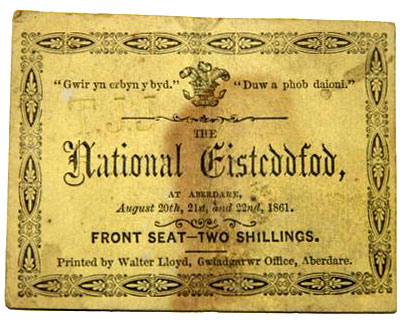
The National Eisteddfod returned to Aberdare in 1885 and again in 1956 by which time the all-Welsh principle had been established, much early eisteddfod business and competition having been conducted in English under the influence of an anglicised gentry and nobility.
The venue for the 1861 Eisteddfod was the Aberdare Market Hall on which can be found a blue plaque which commemorates the occasion. This was unveiled in June 2009.
Since the 1830s, eisteddfodau had been held for which their organizers had claimed ‘national’ status. None had been acknowledged by all concerned as the event in which the national character of Wales and its achievements could and should be asserted. Finally, a group of cultural, social and religious leaders agreed the first recognised National Eisteddfod would be held at Aberdare from 20-22 August 1861. As professor Hywel Teifi Edwards has intimated, a key factor was the ability and readiness of David Williams (Alaw Goch), a local coalowner and eisteddfod enthusiast, to underwrite the cost of the venture here.
The event’s intended home was the site of the Old Boys’ Grammar School (Cae Jacky). On the Sunday before the Eisteddfod was due to start on the 20th, a tempest tore through the district and destroyed the pavilion erected to welcome thousands of visitors. Barely a day was in hand to avert disaster. Immediately, Alaw Goch paused work at his collieries and set his men to adapt the Market Hall as the Eisteddfod’s new home, thus saving it from probable permanent collapse and saving also the good name of Aberdare and his own as the National Eisteddfod’s first treasurer and financial saviour. The festival’s first day-president was Henry Austin Bruce, M.P.
The present Market Hall was not Aberdare’s first such building. The initial market premises were located at the site of what subsequently became the Old Town Hall in High St., opposite the Constitutional Club. This first hall had been built c.1820 but proved too small for the busy trade of mid-19th century Aberdare, then a bustling centre of the rapidly expanding south Wales coalfield.
A group of local worthies sought an act of parliament to establish a new market hall. An Act was obtained in 1852 and construction of the complex we know today began. Its completion was not, it seems, straightforward. There were problems of funding and of construction as evidenced in the local press. Yet work was underway in 1853 as the frieze on the Hall pediment indicates.
In August 1853, an eisteddfod at the Stag Inn, Trecynon organised by William Williams, Y Carw Coch (a famous figure of the day) and his friends (including David Williams, Alaw Goch) rewarded two sets of verses praising Aberdare’s “new market house”. These appeared in Gardd Aberdâr (1854) a volume dedicated to Henry Austin Bruce, M.P., one of the new market company’s directors and later Lord Aberdare. One stated:
It has walls that no wind - and no rain Can easily breach: They’re made of hewed stone, Firmly fixed, like a rock they stand. [p.238; trans./dld]
This verse proved prophetic in the light of events in August 1861 which saw the transfer
of the Eisteddfod from its intended site to a new Market Hall that was capable of withstanding
any tempest or storm. It is currently believed that this 1861 ticket for the first-ever
National Eisteddfod is the only one to have survived anywhere in Wales. It is obviously
most appropriate that it should have survived, albeit by accident, at Aberdare.
Cynon Valley History Society is a Registered Charity. Charity No. 510143.
All information © Cynon Valley History Society