
The Headmasters
MR. DAN ISAAC DAVIES, B.Sc., H.M.I. (1858-1867)
T HE Park Schools, we believe, hold a unique position in the schools of Wales. Its headmaster, Mr. D. I. Davies, and two of his assistants, Messrs. John Rees and Gomer Jones, B.A., were appointed Inspectors of Schools by the Government, while another pupil, and pupil-teacher, (Sir) T Marchant Williams, was elected by the London School Board to be their Inspector of Schools in the Metropolis. Many of the most prominent public men in Wales, holding various positions of trust in judicial, administrative, and educational spheres, and as agents and managers of industrial concerns, received their early education in the Park Schools.
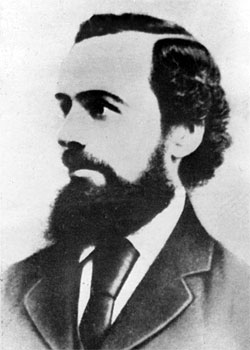
Dan Isaac Davies
It was during Mr. Dan Isaac Davies’s period as headmaster that the school really commenced to flourish, and to proceed on its successful course. The committee soon found cause to congratulate themselves on their choice. He was a born teacher, a skilful organiser, zealous and enthusiastic in all he did. He was appointed Christmas 1857, and commenced his duties early in 1858, after being trained at Borough Road Training College, London. At the time of his appointment, a disastrous coal strike seriously affected the economic position of the district. Many of the parents could not afford the school pence for the education of their children, ranging from 1d. and 2d. for infants, to 3d. and 4d. for boys and girls. This was the time of large families. The last quarter of 1857, the average attendance had been 64. During Mr. Davies’ first week, his average attendance was only 45, but as the people realised his worth, the numbers soon increased. Children walked long distances from Cwmdare, the Town, Abercwmboi, Cwmbach, and Cwmaman, etc., until they had schools of their own. By the end of the year, his average had risen to 181. And it continued to grew, for the year 1859 it was 233; for the year 1885, 485; for the quarter ending June 30, 1866, 512; the number of scholars on the books on Monday, July 2nd, 1866, being 728.
A PARENTS’ DAY IN 1860
We speak to-day of parents’ day as an innovation, but Dan Isaac Davies organised annual parents’ days at that time, marching the children—boys, girls and infants—down to the Temperance Hall (now the Palladium), Aberdare, singing in orderly procession, after having been regaled with tea and cakes at the schools by the ladies—Mrs. Edwards, Mrs. Wigley, Mrs. Jones, druggist, Miss Williams, Ynyscynon, Mrs. Williams, London Warehouse, etc. A report appears in “Y Gweithiwr,” of January, 1860, of one of these parents’ days, when members of the first committee appeared on the platform—Alaw Goch, John Jones, Rev. Thomas Price, Phillip John, Lewis Griffiths, Rev. William Edwards, with new supporters such as Mr. Thomas Williams, grocer, etc., London Warehouse, Harriet Street (later Alderman, and J.P. of Gwaelodygarth, Merthyr), and Mr. Richard Pardoe, ironmonger, Cardiff Street.
The children were examined by the Inspector of the British and Foreign School Society, in reading, spelling, mental arithmetic, geography of England and Europe, the history of England, Scriptural knowledge, and “gave satisfaction.” It was reported that time did not allow for questions on grammar, arithmetic on slates, composition, mensuration, algebra and euclid, all of which were taught the children of the workings classes of Aberdare. The children sang songs, and recited. They had been previously examined in the school by the Government Inspector (Mr. J. Bowstead, M.A.). At this time, Mr. Davies was in charge of the whole school.
A few months before this (in August, 1859), the huts which had been erected on the Common, called “Tai Un Nos,” were demolished, and the Rev. John Griffith, M A., was presented by his friends on his leaving to become the Rector of Merthyr, and a great Welsh patriot. During this same month, a great bazaar was held, when a profit of £400 was made to reduce the debt on St. Fagan’s Schools. During September, the children of Cwmbach Band of Hope enjoyed a picnic by barge on the canal down to the Navigation and Llanfabon, and tap water was turned on for the first time in the houses of Aberdare.
LARGER SCHOOLS AND STAFF
The great increase in the number of children necessitated a much larger school and a larger staff. On March 31, 1864, Miss Margaret Edwards, of Blaina, Mon., who had been trained at Stockwell Training College, London, and was the step-daughter of the Rev. William Roberts, “Nefydd,” was appointed to take charge of the girls’ and infants’ departments at Ebenezer Chapel. The master and mistress soon fell in love with each other, and were married at Ebenezer Chapel on January 4th, 1865.
During the winters of 1864 and 1865, Mr Davies had opened night schools for boys who had had to leave school early to help their parents. The average attendances were 34 (in 1864), and 71 (in 1865).
At last, the great day arrived. The more commodious school was ready, and was opened with great joy on March 13th, 1865. This was a costly venture for poor people to undertake, but they were full of hope that the Nonconformists would rally to the support of the school. They were not disappointed, for at an annual meeting, held at the Temperance Hall, on July 5th, 1866, they reported that the big debt on the new schoolrooms had been wiped out. The Nonconformist churches had come to their rescue in a most noble fashion, and on March 5th, the managers were in a position to declare to “The Lords of the Committee of Council on Education” that the payment of the grant of £515 promised by them would enable the committee finally to close the building account. The money was received soon afterwards, and schools were free of debt. This is the first record of a grant from the Government towards the building costs. The churches of the district, though they had their own building debts to face, subscribed as follows: Moriah, Llwydcoed, £5; Bryn Sion, Trecynon, £8; Hen Dŷ Cwrdd, Trecynon, £63; Baptist, Trecynon, £26; Ebenezer, Trecynon, £45; Carmel, Trecynon, £18; Bethel, Gadlys, £10; Salem, Robertstown, £12; Siloa, Aberdare, £35; Bethania, Aberdare, £22; Tabernacle, Aberdare, £14; Nazareth, Aberdare, £12; Soar, Aberdare, £10; English Unitarian, Aberdare, £10.
Donations were received from Rt. Hon. H. A. Bruce, M.P. (£10); Messrs. Richard Pardoe (£10), (Judge) Gwilym Williams, Miskin (£7 13s. 0d.), Thomas Williams, J.P., Penydarren (£5), David Jones, butcher (£5), John Lewis, Commercial Street (£5), H. H. Vivian, M.P., Swansea (£2 2s 0d.). These were all second donations. Bwllfa Colliery sent £5; Mr. H. Cosham £5 5s. 0d; and Mr. Louis, colliery agent, £1. The Committee of Eisteddfod Undebol, Aberdare, and the Aberdare United Choir, led by Caradog (the nucleus of the famous Côr Mawr of 1872 and 1873), had assisted materially. The committee were glad to report that they now had “large, well-ventilated, well-fitted, and in every way commodious schoolrooms, situated in a most healthy spot, surrounded by extensive playgrounds and gardens, covering altogether an acre and a quarter of freehold ground, which, with residence for the master and mistress attached, may be safely set down as worth from £2,500 to £3,000.” Truly a great task well done.
EXCELLENT GOVERNMENT REPORTS
The three departments received excellent reports from the Government. The managers reported, “That the Lords of the Committee of Council on Education have recently acknowledged the value of Mr. Davies’s service as teacher of the Aberdare British School by raising his certificate to the 1st division of the 1st degree of merit, which, being the highest attainable, he may well feel proud of . . etc. The inspector’s reports showed “that the managers have been very fortunate in securing the services of the mistresses of the girls’ and infants’ schools—Mrs. Davies and Miss Jenkins . . etc.”
“To meet the very poor, arrangements have been made to give education free of charge to 100 destitute children,” said the reports, which appealed for subscribers of 2s. 6d. annually and collections from congregations, etc.
Mr. Dan Isaac Davies, in addition to making such a great success of his school (assisted by the pupil teachers and monitors he had trained), also threw himself heart and soul into the chapel activities at Ebenezer, where he was elected a deacon, superintendent of the Sunday School, secretary of the church and the Band of Hope. He was also secretary of the Sunday School Union for the whole Parish of Aberdare (Hirwaun to Mountain Ash). He also formed a Bible Class, which met at Ebenezer at 7 o’clock on Sunday mornings.
Their first child, Mary Margaretta, was born at the school house (seen on the left of the 1866 picture), on Monday May 14, 1866. To the great dismay of the parents and pupils, Mr. and Mrs. Davies left the school on April 4, 1867, following his appointment as Principal of the Swansea Normal Training College. He soon left for England, where he had been appointed assistant inspector of schools, one of the first so chosen from the ranks of practical teachers in elementary schools. On his return from England in 1883, he became “the leader and first prophet of the bilingual movement, while his activities (by means of talks, speeches, papers, correspondence, and committees), were ceaseless.”
As a result of his labours, on September 19, 1885 (after the National Eisteddfod at Aberdare), there was formed “The Society for Utilising the Welsh Language,” now called “The Welsh Language Society” (“Cymdeithas yr Iaith Gymraeg”).
He died, worn out by ceaseless efforts on behalf of the Welsh Language on May 23, 1887, a comparatively young man, aged 48, mourned by a whole nation, and laid to rest in Cardiff Cemetery. A tablet, attached to the Park School Building, was unveiled by Sir J. E, Lloyd, P.B.A., M.A., D.Litt., on behalf of the Welsh Language Society, on December 7, 1935.
An excellent article on Dan Isaac Davies, by an old Ysgol y Comin scholar, Mr. J. Ifano Jones, late Welsh Librarian at Cardiff, appeared in “The Welsh Political and Educational Leaders in the Victorian Era.”
MR. WALTER HOGG (1867—1876)
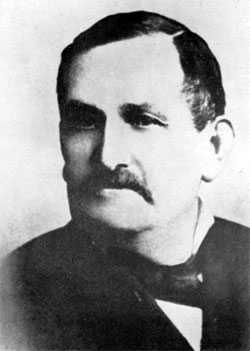
Walter Hogg
On the departure of Mr. and Mrs. Davies, Mr. Walter Hogg became master of the boys’ department. Mr. Hogg occupied the house seen on the right in the 1866 picture. Mr. Hogg continued the tradition of Mr. Dan Isaac Davies, training a large number of pupil-teachers and monitors, who later filled responsible posts in the Rhondda schools as they were being opened. One old scholar describes Mr. Hogg as “brave, strong in body and mind.” He contested the Aberdare School Board Election in 1874, but was unsuccessful.
He was a strict disciplinarian, and a serious teacher. Mr. J. Ifano Jones tells us that he remembers a large number of the scholars returning in the evenings, at his request, to sing songs from the sol-fa in small books called “The Blackbird,” “The Nightingale,” etc, but woe betide the scholar who came to school at 9 a.m. the next morning without his “task” done. The pupils of all ages, and the monitors, were glad to do all that he wished them to do. During Mr. Hogg’s time, classes in connection with the Science and Art Department, South Kensington, were commenced. On the transfer of the schools to the Aberdare School Board, on April 27, 1876, Mr. Hogg resigned, and was appointed an official of the Bedwellty School Board. Later on, he became the organiser of the Glamorgan County Council’s Evening Science and Art Classes.
MR. WILLIAM D. LEWIS, 1876—1881
Mr. Walter Hogg was succeeded by Mr. W. D. Lewis, who was the son of the first schoolmaster at Hirwaun. He had been trained at Bangor Normal College, and like Mr. Hogg, was a keen musician. He was another strict disciplinarian, and of a military bearing. His stay was short, as he resigned after five years.
MR. JOHN GRIFFITHS, 1882—1911

John Griffiths
Mr. John Griffiths, a native of Llangrannog, and a former pupil of Cranogwen, was appointed head-teacher of the Llwydcoed Boys’ School, serving there from January, 1878, until January 27, 1882, when he succeeded Mr. Lewis at the Park Boys’ School. This is the genial and kind-hearted “mishter” that the majority of the grown-up male population of Trecynon remember. He was very fond and proud of the boys of Ysgol y Comin, and this feeling was reciprocated by the children and the staff. He served a longer period at this school than any of his predecessors or successors. As time went on, and the school population grew, the staff was increased by persons of more mature age, and by teachers who had been trained at the training colleges, so that Mr. Griffiths did not have to rely wholly upon pupil-teachers and monitors, as the early masters had to.
Mr. Griffiths left the music lessons and the singing to the members of his staff, many of whom were keen musicians, such as the late Mr. Evan Jones, who for a time served in the U.S.A., and Mr. Miles Thomas, who was so kindly written of by one of his former pupils, Dr. John Thomas, in the “Aberdare Leader” of November 6th, 1948. A very large number of Mr. Griffiths’s former staff have served as head-teachers at Aberdare and elsewhere. A keen Welshman, he was one of the founders of the Aberdare Cymrodorion Society, and a successful teacher of Welsh at evening classes. Mr. Griffiths conducted classes in the “Principles of Agriculture,” “Botany,” and “Hygiene,” under the Glamorgan County Evening Classes and the South Kensington Science and Art Department.
Though Mr. Griffiths had left Llwydcoed, he continued to act as deacon, and Sunday School teacher and treasurer of Horeb Congregational Chapel, a post which he filled for 40 years. He was also elected a trustee of Ebenezer Chapel, Trecynon, and curator of the former Aberdare Naturalists’ Museum. After resigning as headmaster (July 28, 1911), he assisted for many years on the clerical staff of the Aberdare Education Office.
During Mr. Griffiths’s time, great changes took place in the school buildings. Under this scheme of reconstruction, a new infants’ school was built in 1894, and the infants were removed from the original building of 1848 to the present infants’ department, probably some time in 1895. The school-mistress’s house was taken down, and the old school building extended to the road. This was accompanied by changes in the re-organisation of the departments. Up to this time, the boys departments had occupied the ground floor of the big school, while the girls’ department was upstairs. Now, the order was reversed, the boys going upstairs, and the girls downstairs, as they do to-day. In August, 1903, additional class-rooms were opened for the boys’ and girls’ departments, and also a cookery centre.
MR. WILLIAM THEODORE ROBERTS, 1911—1920
Mr. Roberts had succeeded Mr. Griffiths at Llwydcoed, in 1882, and he now again followed him at Park Boys’ School, in 1911. But in the meantime, while Mr. Griffiths had remained at Park Schools, Mr. Roberts had served at Blaengwawr Boys Schools, from July 5, 1886, until July 26, 1907 (a period of 21 years), and then at the Town Boys’ School, from August, 1907, until the end of August, 1911, when he was transferred to Park Boys’ School. Here he remained until he retired on the last day of 1920, after serving faithfully and conscientiously as head-teacher of schools in Aberdare and district for nearly 39 years. Naturally, he would be better remembered by Aberaman people as the head-master of Blaengwawr Boys’ School.
MR. GEORGE JENKINS, 1921—1934

George Jenkins