
The Aberdare British School in 1848
A FTER that memorable meeting at Siloa,
on February 23rd, 1848, the Nonconformists of Aberdare elected a strong committee to
proceed immediately with the construction of the British School.

Alaw Goch
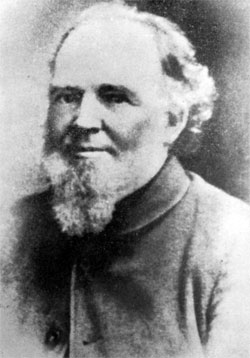
John Jones, Druggist
Alaw Goch was appointed chairman, and remained so until his sudden death in 1863. John Jones, druggist, of the “Ceffyl Gwyn,” No. 1 Commercial Place (now called Victoria Square), was elected treasurer, and succeeded Alaw Goch as chairman, on the latter’s death. John Jones, was, at this time, one of the most influential men in Aberdare, and well-known throughout Glamorgan. He was clerk to the Road Board for North Glamorgan (including the Aberdare and Merthyr Valleys), clerk to the Parish Vestry (which then performed duties later undertaken by the Aberdare Board of Health, and which are now done by the Aberdare U.D.C.). He was the first secretary of Highland Place Church, and director and chairman of the Aberdare Water Works Co. During 1859, when there appeared a danger of this country going to war with France, and of a French invasion, John Jones was elected chairman of the first meeting to organise the formation of the local Voluntary Corps. His descendants still carry on the chemist’s business at 3 Victoria Square. About 1830-35, John Jones was Aberdare’s Postmaster.

Dr Thomas Price
The secretary was the redoubtable Rev. Dr. Thomas Price, of Penpound. One of the most popular men in Wales, he was a member of the Aberdare Board of Health, of the Aberdare Burial Board, and (after its formation), of the Aberdare School Board, editor of the Welsh weekly newspaper, the “Gwron,” a popular preacher and lecturer, a great organiser of literary and educational societies in his church at Calfaria, and, through his boundless energy, the founder of many daughter churches of Calfaria at Aberaman, Abernant, Gadlys and Ynyslwyd.
These three stalwarts were assisted by the Revs. Wm. Edwards, of Ebenezer Welsh Congregational Church, Trecynon, David Price, of Siloa, Joshua Thomas, of Saron, Aberaman, and by the recognised leader of the Calvinistic Methodists, Mr. Evan Griffiths, of Ty Mawr (grocer, draper, and ironmonger), who owned a number of boats on the canal, and acted as a carrier of goods to and from Cardiff.
SCHOOL BUILT IN SEVEN MONTHS
With such prominent leaders and men of business at the helm, things began to hum, and they soon secured a quarter of an acre as a site for the new school on the old “Comin” from the Marquis of Bute, as Lord of the Manor of Miskin, in which the common was situated. They obtained subscriptions of £10 apiece from Messrs. Richard Fothergill, of Abernant, H. A. Bruce (Lord Aberdare), Thomas Wayne, of the Gadlys Iron Works, Dr. James Lewis Roberts, of Gadlys Uchaf, and Alaw Goch, who also left £100 in his will for the school. It has been said that the ceremony of laying the foundation stone took place on Monday, March 13, 1848. A sum of £120 was collected from the miners, colliers, and ironworkers. Plans were drawn by Mr. Evan Griffiths, junior, of the Poplars, architect and surveyor, and the cost was to be about £530 with extras. Work now proceeded apace, and in about seven months, the school and the master’s house were ready.
In the issues of the “Principality,” a weekly newspaper published at Cardiff, which was strongly opposed to State regulation of religion and education, of September 22nd and 29th, 1848, there appeared this advertisement:
TO BRITISH TEACHERS
ABERDARE BRITISH SCHOOL
“The Committee of the above, school (which is intended to be opened in a few weeks), are desirous of engaging an efficient teacher, salary £50, together with an excellent house, and garden adjoining the school-room. All applications, with testimonials and references, to be sent, on or before October 10th, to Mr. John Jones, Druggist, Aberdare, with the words, “For British School,” on the cover. A teacher conversant with the Welsh language will be preferred, other qualifications being equal”
(Signed) THOMAS PRICE
WILLIAM EDWARDS
Aberdare,
September, 20, 1848.
It has not been ascertained when the appointment was made. It may have been on the date mentioned above, October 10th. and the school opened for the reception of the first scholars soon afterwards. But as the building was sufficiently far advanced, a monster tea party was arranged for Monday, October 9th. when it is said that 2,614 paid a shilling each for admission. The profit, no doubt, was urgently required to meet the builders’ bills, etc. On the occasion of opening the school, the chairman, who was well-known as a Welsh bard, read out six stanzas (englynion) he had composed for the occasion. One of them read as follows:
Ni raid i’ch fyn’d i Rhydychain-mwy.
 Na myn’d chwaith i Lundain
Oherwydd ceir ar Hirwaun
 Feib rhwydd aiff heibio i’r rhai’n.
THE FIRST HEADMASTERS
The Rev. Thomas Price, in an article in “Seren Cymru,” is reported to have written that the committee were not fortunate in their choice of the first three headteachers, as it is reported that they served for only a short period of three years. One was Mr. Thomas Taylor, who served until 1851. The next master was Mr. John Anthony, who served from 1851 (or 1852) to 1857, when he resigned. In a report of the school examination held in 1852, the children were complimented on their ability in answering the questions asked them, and the master was praised for his skill and thoroughness in preparing the scholars for the examination. It should be mentioned here that the Government appointed two inspectors for schools, one for the church schools (who would have to be approved by the church authorities and the archbishops), and the other for the British Schools and the Wesleyan schools (who would have to be approved by the British and Foreign School Society).
CONVEYANCE IN TRUST, OF SCHOOL SITE FOR £10